Friday, March 26, 2010

Bangkok Dangerous?

A blog about Thailand wouldn't be complete without some discussion about the political instability. My arrival to Thailand was drastically altered because Suvarnabhumi Airport (Bangkok airport) was closed due to protesters storming it and occupying it for over a week! Soon after, the ruling government party was found guilty of electoral fraud and a new government was established.

I won't go into details about the different political parties and their stances (they all claim to be fighting for democracy), but it is apparent that they aren't happy with the way things are. Coups and changes of government aren't a new thing in the land of smiles. Since the last military coup in 2006 the Thai government has changed hands four times. There have been 18 coups since the constitutional monarchy was established in 1932.

At first, I was a bit concerned about my safety and the state of the country, especially with the events that unfolded during Songkran (Thai New Year) of 2009. However, since then anti-government protesting has been common place - typically occurring every month. The continuous civil unrest eventually became a normal part of living in Thailand. Yeah, we got the notices from the US embassy about imminent danger and the response would be, "meh, there they go again with the protesting". In reality, there wouldn't be very many protesters and they would conduct peaceful demonstrations.

The latest round of protests in March created a new benchmark regarding tactics. The 'red-shirt' anti-government protesters announced their rally about a month in advance. They claimed that a million people from all over the country would unite in Bangkok to show their displeasure at the current government and cause havoc in the capital city. This allowed both the government and the citizens of Bangkok to be prepared for their arrival. The government had tens of thousands of troops and riot police stationed throughout the city during the rally weekend. Businesses chose to close down during the weekend and some people left the city for those few days to avoid the situation.

The red-shirt protesters did make their way to Bangkok but rather than a million people it was more like 100,000 people - still an impressive figure. The government allowed the peaceful protests continue through the weekend as long as things wouldn't turn violent. They even closed roads in the city to allow the protesters to parade through.

The protesters causing a lot of traffic at Asok Rd and Sukhumvit Rd.

One of the parade routes passed in front of my place of work (in the elephant building). There was a long expanse of cars as far as I could see in both directions with people hanging out the windows or riding in the back of trucks sporting their red clothing and flags. The atmosphere was very festive and cheerful. The street was dotted with supporters wearing red and cheering their fellow party members in the parade. It felt more like a homecoming parade than a political rally.


Near the end of the protester's motor parade on Paholyotin Road


The next day I encountered the protesters again. This time I was riding my bicycle. I rode my bike alongside the protesters and captured video and pictures of the festive atmosphere with my iPhone.

Riding with the red-shirts on Silom Road


Red-shirt protesters on Silom Road


Silom Road

Lots of traffic on Silom Road

Waiting at the light


After a peaceful weekend of protesting, the leaders of the red-shirts wanted change. They demanded the current government to step down and conduct new elections. If the government didn't dissolve within 24 hours, then a "blood bath" would occur. The 24 hour deadline passed without any change - the government was staying pat.

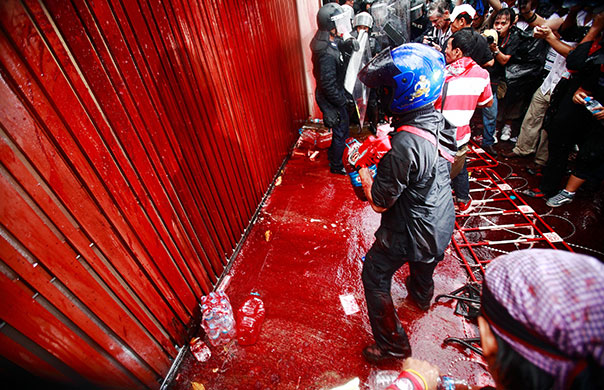
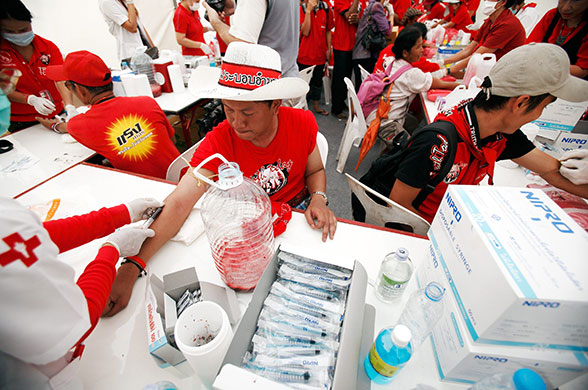
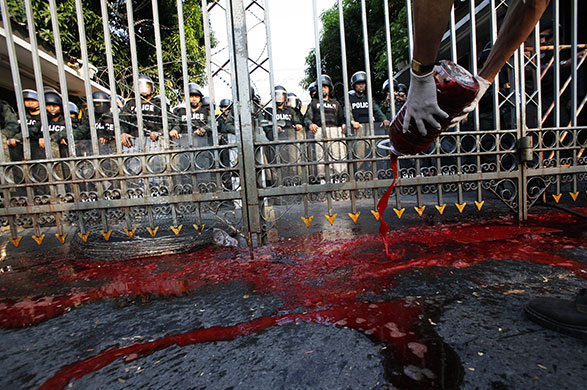
This is when things got really interesting...and really, really grotesque. True to their word, the protesters created a blood bath - of their own volunteered blood. The protesters donated a little bit of their own blood so that it could be splashed on the gates of the government complex and on the property of the Thai Prime Minister. As the blood was splashed, a blood curse was performed against the current government. Below are graphic videos and pics of their work.


Photograph: Athit Perawongmetha/Getty Images
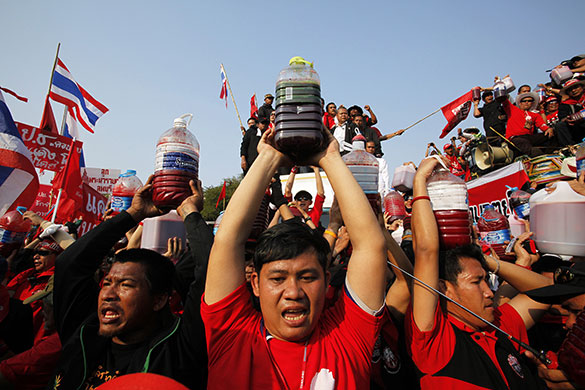

Photograph: Sukree Sukplang/Reuters


Photograph: Sukree Sukplang/Reuters

Photograph: Athit Perawongmetha/Getty Images


It appears the government will not step down. The protesters are still in town, but their numbers are dwindling. Life has returned to normal in Bangkok, but I'm sure that in the not-so-distant future another rally will be held. Could they possibly do another stunt to outdo the 'blood bath'? Regardless of party affiliation, all this instability greatly damages the image of Thailand to outsiders. Who would want to come to Thailand based on the images above? Sadly, the tourism sector takes a hit after each incident. Thailand has a lot to offer to tourists - wonderful beaches, excellent cuisine, charming people, but unfortunately political unrest is part of their culture as well.

Sunday, March 7, 2010

Cooking Thai Food


“Where has this cuisine been all my life? Why am I in my mid-twenties and just now discovering this amazing food?” These were my thoughts after eating several dishes from the “Thai Cottage” restaurant in Houston. After I sampled the chicken yellow curry I was hooked. It seemed to carry the perfect balance of sweetness from the coconut milk with the wonderfully spicy, aromatic, and exotic flavor from the curry. It was topped with potatoes and carrots and served with steamed rice. What more could I want? I could have literally eaten that dish every day of the year.

The only other Thai dishes I had before coming to Thailand were Pad Thai and chicken satay. My experience in the U.S. was that the Pad Thai was hit or miss, either really good or just OK. The chicken satay with peanut sauce was generally good anywhere and the curry dishes were always flavorful, tasty, and spicy (depending on how you much you dared to try, I typically asked for medium spiciness).

Naturally, when I arrived in Thailand a little over a year ago, I was very excited to get a taste of actual authentic Thai cuisine. One of my first meals included a chicken satay with peanut sauce that blew away anything I had ever had in the U.S. I also tried out Tom Yum Goong for the first time and immediately fell in love with it. This brown soup had all kinds of unidentifiable cut-up herbs and spices in it plus pieces of shrimp, fish, squid, and muscles. It had a perfect balance of flavors - sweetness, sourness, spiciness, and saltiness. Even though it was spicy, the spiciness surprisingly complimented the flavor rather than overpower it. I was left with a tingling hot mouth that felt pleasant which curiously didn't need to be urgently extinguished as is the case with most spicy food. I felt a warm glowing happiness and my taste buds were in bliss. This is when I knew that Thai food was going to be my new favorite cuisine.


Over the weeks and months during my stay here, I have tried many more Thai dishes, most of which I had never heard of before. I've also tried the different tropical fruits including pomelo, jackfruit, custard apple, mangosteen, longan, and durian. I learned how to eat Thai-style with a spoon rather than a fork (spoon in the right hand for eating, fork in the left hand for cutting and scooping food into the spoon) and to eat noodle soup with a spoon in the left hand with a pair of chopsticks in the right hand. The toddlers and kids have it right, eating with a spoon is so much easier!

After a year of eating all this excellent food and telling myself that I should learn how to cook it, I finally took the leap and signed up for a 5 day course at The Somphong Thai cooking school. It is located at the end of an alley off a busy street (Silom road). The school is actually the home of an old Thai lady, Somphong, in a traditional outdoor (and covered) kitchen. Along the main wall are a series of gas burners with woks at the ready. The other wall serves as an open air pantry and display of various fruits, vegetables, herbs, and sauces. In the middle of the kitchen is a large table for food preparation. During the course of the week, I learned that this area is not only where the cooking classes are held but it serves as the hangout spot and dining room for the family itself. I couldn't have picked a more authentic place to learn how to cook Thai food.


The Silom Market

This is how my first day went.

The school is managed and run by Somphong's niece, Koy. The class begins with a trip to the local market. The open-air market is nothing more than a side street crammed with food vendors all along both sides. Koy tells us to be careful of the passing motorcyles and tuk-tuks and leads us to a small walkway that surprisingly opens up to a huge covered market. Half the market is dedicated to freshly cut meat where both live and freshly cut fish are on display for sale. With wicker baskets in hand, we follow Koy to a coconut grinding stall. We see how shaved coconut is made from fresh coconuts (grinding machine), and how coconut cream and coconut milk is made from the shaved coconuts (mechanical press). She explains how to make an order and how much it should cost.

Curry Pastes and bottled sauces


Koy explaining the various peppers

A look around Silom Market

We continue through the market stopping at various points where Koy talks about the various foodstuff there. I learn many things such as: all the curry pastes can be bought (easier to buy than to make by hand, but we will learn how to do it the hard way), shrimp paste is made by marinating a salt mixture with baby shrimp for a year (no wonder it stinks so much!), there are at least a half dozen types of eggplant, at least a dozen different types of pepper (the smallest ones are the hottest), and 3 types of basil in Thailand. Throughout our tour Koy buys and fills our baskets with our ingredients for the day. We make our way back to the school to let the cooking commence.


Our classroom - A traditional Thai style open-air kitchen

We are equipped with a bright purple apron, a matching purple napkin, a wooden cutting block, and a rather large knife. Koy hands us our recipe books and begins the class explaining how to make curry paste. Using a mortal and pestle, we hand grind a mixture of ingredients (mostly chilies, herbs, and spices) until it becomes a smooth paste. The work is difficult but we are rewarded with an excellent green curry paste. She shows us how to cut various vegetables and gives us pre-measured containers of seasonings (sugar, salt, fish sauce, coconut milk, etc). With all our ingredients ready, we go to the wok and cook away as she tells us what to add and how to long to cook. Within minutes, we have completed our first dish, a great looking bowl of chicken green curry. We all go to the back room (thankfully air-conditioned) and try out our first dish. It's the best green curry I've ever had! I may be biased but, really, it was the best green curry I ever had. And I can say that I cooked it – from scratch!

Koy is demonstrating how to cut various vegetables

Woks in action!

The rest of the day, and indeed, the rest of the week followed the same pattern. We prepared, cut, and mixed all of the ingredients first, then we went to the woks and slowly added everything until another culinary creation was completed. Cooking Thai food was, dare I say, actually pretty easy. Looking over the entire process, the most difficult part is collecting all the not-so-common ingredients from the market (I'm sure this is especially more difficult in the US – you'd probably have to go to a special Asian store for some of the ingredients). Once you have everything, the prep time is fast (cutting, chopping, mixing) and the cooking time is even faster.


Ingredients to make Green Curry Paste

Thai cuisine is famous for being spicy. Most people who like spicy food will come to love Thai food. I was never a fanatic about spicy food, but after tasting the local food I've become a lover of spicy Thai food. The secret is not the type, amount, or strength of chilies, but rather the balance of spiciness with flavor. I had great joy learning about this aspect of Thai food during the course. Before preparing a new dish, Koy would explain the specific flavors we were trying to achieve then tell us about each ingredient and how it contributed to the overall balance. For example, Koy would explain that sweet sticky rice with mangoes should taste sweet and a salty (it's not a Thai style dessert if it's not a little salty). Thus, we add coconut milk, sugar, and salt. What pleased me was that all dishes usually had 2, 3, or 4 simple flavors delicately mixed to create an overall masterpiece. Such is the case with Tom Yum Goong. The end result should taste sweet, sour, spicy and salty. For this combination we add (among other ingredients) appropriate amounts palm sugar (sweet), lemon juice (sour), chilies (spicy), and fish sauce (salty). By the end of the course I had a pretty good idea of what to add to achieve a desired flavor.

We also learned some simple presentation techniques. This included making a rose from the skin of a tomato, learning how to wrap chicken in Pandanus leaves (imagine doing origami with banana leaves), garnishing plates with various flowers, and topping dishes with hand-made sauces.


My lovely rose made from a tomato

I've finished the course and learned how to make 25 Thai dishes. I'm still amazed at how easy it is to cook such wonderfully delicious, yet simple dishes. After successfully cooking several dishes at home after the course, I can confidently say that I cook Thai food! :)


All in a day's work

Even though it may be 100 degrees outside, I can understand why people in Thailand will still eat sweatingly spicy food. Thai food makes you happy. It tastes so good, and it's been shown that the capsaicin in chili peppers causes the release of endorphins – the happy chemical. Despite the problems and poverty in Thailand, the people, for the most part, continue to be happy. I think their food has a lot to do with why Thailand is known as “the land of smiles.”


My Culinary Creations!
(Click to see a slideshow of my dishes)

Saturday, August 1, 2009

I survived the H1N1 swine flu

If you don't know anybody that became infected with the H1N1 swine flu you do now. Me. Yes, I managed to contract the virus here in Bangkok, Thailand. I never thought I'd get the swine flu but here I am talking about it.


The H1N1 "swine" Flu virus has been a major story for 2009. The virus rapidly spread itself around the world and quickly developed into a flu pandemic. In Thailand, there were no reported cases at first. However, over time a few confirmed cases popped up from travelers. Then, non-traveling local Thais became infected. Finally, large populations of students in Thai schools became infected. At this point the Thai government stepped in and began their H1N1 initiative. Millions of masks were handed out, schools were closed, public areas were regularly sanitized, and there was more information made available to the public about the flu along with methods of protection and prevention.

Given the worldwide scare and the number of people infected, the H1N1 flu still seemed, to me, like something that "happened to other people" that weren't conscience of good personal hygiene. I like to think that I did a fairly good job being mindful of good hygiene. For example, I always make it a point to never touch my eyes, mouth, or nose when in public places until I've washed/sanitized my hands. This swine flu business is a bit serious but it has also been blown way out of proportion. Plus, I didn't personally know of anybody who had contracted the virus. I thought to myself, "I'll be fine!"

Wrong! I'm not sure how or when I contracted the H1N1 virus, but I did. Here is a recap of the day by day sequence of events.

Wednesday - I felt great. The week before, I had wrapped up my intensive but satisfying 4 week TESOL course. That Monday, I had an interview and received a job offer at a top choice location. With a full week and a half left before the term began, I was excited about the opportunity but looking forward to enjoying some down time. I woke up early so that I could meet up with my fellow classmates, Aey and Kim at the National Thai Museum. We met up, and had a nice English speaking tour of about 15 people on the history of Buddhism in Thailand. Next, we went to a fairly busy market near the river pier and had a long lunch. There weren't that many people in the cafe. Later, we walked around a bit and saw a few sights. Later that night I met up Princeton, his brother, and Princeton's roommate from his mission trip. It had been years since we saw each other. We hung out and ended up watching Harry Potter. As a joke, Princeton wore a face mask because of all the Thai people he saw wearing the masks. We parted ways and I took a taxi back home.

Thursday - I slept in and woke up feeling great. Amber was working and we ended up meeting for lunch. I took the above ground subway (a.k.a. "SkyTrain") and met her at a restaurant in her building. I ordered some chicken curry with a large glass of delicious Thai tea. After the meal, I noticed that my throat was dry and itchy but I didn't think much of it because I rarely drink tea and when I do my throat tends to dry out a bit. I ran some errands and relaxed for the rest of the day, but my throat was still scratchy.

Friday - Again, I woke up feeling great but with some discomfort as my throat was still dry and itchy. That night we met up with lots of friends at Charley Brown's and drank margaritas until the place closed. The alcohol pretty much numbed the feeling in my throat. Maybe it served as a disinfectant too!

Saturday - I woke up groggy. Didn't get enough sleep and my throat was still the same. Met up with most of the friends from the night before at Lumphini Park. It looked like it was going to rain, but it never did. We all had a nice time at the park eating, listening to music, playing cards, badminton, and Frisbee, fortune telling, etc. By the end of the day, I was spent. I came home, showered, and immediately felt really bad - weak, dizzy, and really hot. I assumed that it was exhaustion from being outside all day, plus lack of sleep and water. I had a quick dinner and went to bed early.

Sunday - I woke up feeling like a truck had hit me. My body ached all over. I had a bad headache. My throat felt like crap and I had developed a cough. I felt weak and very tired. My skin was hot to the touch but I felt very cold and wanted to curl up in blankets. I decided that something was wrong and went to see a doctor at the hospital. They took my temperature, I had a high fever of around 101F. They used a long q-tip to swab a sample way down in my throat (not a good feeling, it made me gag, but better than taking blood I suppose) to test for the flu. About 30 minutes later, I was told that I was positive for Influenza type A and I had an upper respiratory infection. The doctor told me I could have the H1N1 virus because it is among the many type A flu strains. For an additional fee, they took another throat sample and sent it to the H1N1 testing center to verify if I indeed had H1N1. The results wouldn't be back for another 3-5 days. The doctor prescribed lots of medicine for me including Tamiflu which is very expensive. About $10 USD per pill!! He gave me 10 pills - 2 per day for 5 days. I came back home and my fever seemed to have broken. I didn't feel hot and cold anymore. I rested for the rest of the day taking many naps.

My Regimen of drugs


Monday - It was a rough night. I woke up every few hours soaked in my own sweat - a pretty nasty feeling. I woke up in the morning feeling awful, weak, and with a constant headache. Unfortunately, we had to go to immigration to renew our visas. I didn't want to go but Amber's company is very finicky about these things and today was the day to go. We spent an hour or so at immigration. I was wearing my mask and trying to minimize my closeness to other people. What would they think if they knew I had the flu? The trip took all the energy out of me. I came home and napped for the rest of the day. My diet consisted of soup, water, Gatorade, and medicine. It was getting very annoying to wake up from sleep or naps in a pool of sweat. I weighed myself and saw that I had already lost (sweated off) 5 pounds.

Tuesday - A slight improvement. The coughing and chest congestion were almost gone - the antibacterial medicine did it's job. A lot of napping during the day. Every time I woke up my body felt like it went through a battle - weary but somehow productive. I felt a tiny bit better after each nap. My body still ached and the headache was still there.

Wednesday - Felt better. I had more energy, less body aches, still had headaches, but the sweating finally stopped. The frequency and length of naps were declining as well.

Thursday - Felt a lot better. I had much more energy and went out for the first time. I walked outside a bit and got some books. It felt good to be outside and walk around. The headache finally went away. I came back and took a nap. I noticed that I lost 10 pounds.

Friday - Felt very good. I had good energy and no more body aches. We decided to celebrate and went out for steak and beer. It felt good to eat such a hearty meal!

Saturday - Felt back to normal. I went to see the doctor for the follow-up visit. He confirmed that I indeed tested positive for the H1N1 swine flu, but that everything was fine now. Good thing, because I started my new job as a teacher in 2 days!

So it took about 10 days from the start of my symptoms to reach full recovery, and I amazingly lost about 12 pounds. Thank you Amber for bravely taking care of me, buying and preparing my food, and making sure I was clean and comfortable. This flu sucked just as bad as any other flu I've had. I have no idea how I got it and I doubt if wearing a mask would have prevented it. I saw so many people wearing protective masks but using them incorrectly! For example, I saw people in the subway holding on to the handrails held by million of other people, then reaching inside their mask to scratch their nose. This is exactly what you're NOT supposed to do people! (on another note, the custom here is to wash your hands BEFORE going to the bathroom, and not after)

I suppose my only "official swine flu survivor" advice is don't be afraid to see a doctor if you don't feel well. I went at the first sign of not feeling well. I'm sure that if I had waited a day or two, the respiratory infection could have gotten real bad, real fast. Lots of people want to tough it out when they don't feel well. Why? Your job or your pride isn't as important as your health. Go see a doctor, get the medication, and rest properly.


Sunday, May 24, 2009

The Evolution of Watching Movies

Watching movies seems to be a timeless form of entertainment. While I don’t consider myself a movie buff, critic, or expert, I won’t pass on an opportunity to watch a good move at home or at the theatre. Naturally, my taste in movies has evolved somewhat over the years. As a child, going to the movie theatre was a family treat. It was a great excuse to indulge in popcorn and candy while watching a rated PG comedy or action film. As a pre-teen, going to the movies was a social event that involved hanging out with friends and a place to meet other people. As an adult, the staple dinner-and-a-movie date was a regular activity.

Interestingly, my movie going experience seems to have evolved in parallel to the development of my tastes. Not far into the “adult phase,” I started to dislike going to movie theatres because the overall experience was no longer pleasant. The price of tickets and food was high. The theatre seemed to be filled mostly with obnoxious, loud, and inconsiderate kids. No movie experience was complete without at least 3 cell phones ringing during the movie, one of which would be answered with an annoyingly loud, full-blown conversation (you know, they have to speak up because there is a movie going on in the background - sheesh). The crying baby is another given. I have nothing against babies crying. It is a natural act. But will the parents wanting to see an R-rated movie please drop off the kids to family, a friend, or a babysitter before coming to the theatre?

Thus, for a while I would rarely go out to watch a movie. However, when Amber and I bought our first house, we decided to bring the movie-going experience home. A big screen high definition plasma TV and surround sound system purchase later and it was done. We had our own movie theatre in the comfort of our home. Although we couldn’t watch the movies titles showing at theatres, we would gladly wait the few months and pay for a DVD or watch them on a premium cable channel. The movie going experience had reached an all-time high.

Now that we are living in Thailand, we do not have a home theatre system. Our cable package, or lack thereof, does not show any movies. As far as DVDs go, there are a million stands littered along the streets with the latest films. But quality DVD’s are hard to come by because they are mostly bootleg copies where someone films inside a movie theatre. Going to a movie theatre wasn’t appealing either because only the biggest, most popular movies from the US even make it to the big screen in Bangkok. Thus, we resigned ourselves to occasionally buy and watch DVD’s at home.

Then, a magical thing happened. We decided to go watch a movie at the Siam Paragon Cineplex. This Cineplex has about 16 screens including an IMAX screen. As soon as I walked into the lobby of the Cineplex, I was completely blown away. First of all, the lobby was huge! It was at least 4 times larger than the largest lobby I’ve seen in the US. The other thing that struck me was how modern and stylish it was. There were several lounge areas scattered about all of which were equipped with hip, plush furniture. There was nice lounge music playing overhead and off to the side was a full scale Starbucks.


The box office


When purchasing tickets at the box office, they show you a video diagram of the theatre and allow you to choose your seats. The ticket price was 140 baht, which is about $4 USD – not bad at all! The concession stand had a wide array of snacks, popcorn, and drinks – including beer for only 60 baht (about $2)! Typical popcorn flavors include regular salted, sweet caramel, and seaweed varieties. At the time, the concession stand was also offering special pink colored strawberry flavored popcorn. I know it sounds kinda gross. But I got a bucket of half strawberry and half regular and it was actually very good! The theatre itself was very similar to any other theatre I’ve been to. The previews and commercials lasted almost 30 minutes. Oh, and just before the movie starts, there was a video tribute to the King of Thailand that we all had to stand for…sort of like standing for the US national anthem. Overall, the experience wasn’t bad at all. One that I’d be willing to repeat should the right movie be offered.

Not too long ago, we decided to watch another film on the big screen. We showed up at the theatre and told them we wanted to see the next showing. The next show was in 30 minutes, but was located in the premium theatre named The Nokia Ultra Screen Cineplex. Sure, we’d try it out. As we were selecting our seats, we noticed there were only about 30 seats in the entire theatre. To our surprise, the cost was 600 baht per person, or about $17 USD. Hmmm…what did we get ourselves into? The answer: complete luxury.

The Ultra Screen Cineplex is a set of 4 premium theatres in their own private wing within the entire complex. It has its own chic bathrooms and a lounge, or galleria as it’s called, for patrons to hang out and wait until the movie starts. The galleria has a full bar with waitresses where ticket holders get complimentary soft drinks, tea, coffee, cookies, and cakes. For ridiculously decent prices, you elect for a beer or cocktail. Among the lounge seating and private tables are massage chairs (full body or leg and foot) to relax you before the movie.

The Galleria Bar


The Galleria main seating area


More seating in the Galleria


Enjoying pre-movie snacks and a drink


After filling up on the yummy cookies and banana muffins, we made our way down the private hallway into our designated theatre.


Look at the theatre seating!


There was an usher there to show us to our seats. The theatre comprised of what I would call Pods. Each pod contained 2 seats, and there were 4 pods per row (4-5 rows altogether). The thing is these weren’t ordinary seats within a pod; they were very akin to first class airline seats. The huge supple leather seats reclined completely horizontal, complete with retractable leg rest at a push of a button. A pillow and blanket was provided, and each pod had ample space for food and drinks as well as its own small coffee table. The usher also doubled as a waitress and took our order of popcorn and beer (Singha for Amber and a Corona for me). The movie screen was a wide-screen with great picture and excellent sound quality (the movies are in English with Thai subtitles). The pods were spaced out so that movie watchers couldn’t bother one another. We could have a conversation with each other knowing we wouldn’t be disturbing other people. The pods on the back row even had private curtains for ultimate exclusivity.

This was easily the most luxurious and comfortable movie experience I’ve ever witnessed. The cost of $17 USD seemed excessive at first, but considering the free food and drinks (and massage chairs) at the lounge, the private and extremely comfortable seating (lying with pillow and blanket is more accurate), the convenient ordering of food and drinks at your seat, the quality of the picture and sound, and the lack of excess people and disturbances, I think it was well worth the price. We look forward to watching all the summer blockbusters in style.

Oh yeah…in addition to these Ultra Screen Theatres, the Siam Paragon Cinema Complex also offers an even more luxurious theatre dubbed the Enigma theatre. According to a review online, instead of seats you get a bed for 2, with plenty of pillows and blankets. Also included are 1 free drink (whiskey, beer included, wine not included), 1 free appetizer, a more private lounge, and far fewer people in the theatre.

Thursday, April 30, 2009

The Power of 'Nong'

My first encounter with the word ‘nong’ was during my first dining experience at a restaurant in Bangkok with my wife. In my experience, Thai wait staff are very friendly and polite yet don’t have as much initiative you would enjoy in the U.S. If I need another drink or a new utensil, the wait staff usually never notice and I have to hail one down. The thing is, the standard hand raise or arm waving with an “excuse me” usually does not work in getting their attention, even as they walk right past you! On this particular day, after my few fruitless attempts to catch a waiter, my wife took over and nearly screamed the word “nong” at a nearby waitress. From my observation the waitress was surprised by being addressed this way and nearly tripped and fell as she tried to locate the source. She saw my wife’s raised hand, realized that it was her who called her, and hurriedly came to our table to attend to us. I was quite amazed at the response.

The response seems to be the same no matter which restaurant we are at or the age or gender of the wait staff. Whenever the word “nong” is said, it seems to send a jolt of attention to the wait staff - similar to a grazing deer that suddenly hears a noise and snaps it head up to locate the source. Some waiters stop abruptly in mid stride, while others nearly spill the tray in their hand. It seems to always get their immediate attention and prompt service. For a while though, I never used the word myself because I didn’t know the meaning and my wife didn‘t know either. It was just one of those things she picked up after living in Thailand for over a year. For all I knew, their reaction could have been because the word was derogatory, though they never seemed to be offended. After a little research, it turns out that the Thai word 'nong' has several meanings and can demonstrate friendliness, politeness and fondness.

Per The Grolier International Dictionary the definition of 'Nong'

1. a younger brother or sister
2. a form of address used by an older person to a younger person as a sign of a certain amount of friendliness or politeness
3. a polite form of address to someone serving you, such as a waiter or shop assistant, or someone in a similar position.

Basically it’s the English equivalent of saying the word ‘sir’ to a younger person(s) of customer service. It is a polite way to get address them and get their attention. I’ve never heard another foreigner use ‘nong’ so it must be a surprise to them when my non-Thai wife addresses them in this manner. This is the secret of ‘nong’. Now, it is quite amusing to witness the numerous foreign diners that get frustrated at their futile attempts to call for service - I was like that once.

It’s all about the power of ‘nong’!


Amber with one of the Thai waitstaff at The Blue Elephant restaurant


*For those interested, the Thai word ‘pee’ is the opposite of ‘nong’. The Thai word ‘pee’ means older brother or sister, and is the equivalent of ‘sir’ when addressing an elder or someone of higher rank or responsibility

Wednesday, April 29, 2009

Learning the Thai Language

As of this writing I have completed 3 series of Thai language classes and I am currently taking the 4th. Each class consists of twenty 3-hour days with homework and tests. The first and second class emphasize proper phonetics so that basic conversation skills are learned. The higher level classes teach the Thai alphabet, reading, writing, and various subjects of Thai culture. I am still amazed at the complexity of the Thai alphabet and writing system, yet at the simplicity of speaking. Here are some interesting points I have learned about the Thai language so far.
 
Tones
Initially, the most difficult aspect of the Thai language is to learn are the 5 different tones a word can have. The English language is non-tonal, therefore, most words have only one way to be pronounced. However, a Thai word can have 5 different ways of pronunciation, or tones - each with a different meaning. At first, all 5 tones sounded the same to me! However, with good teaching and practice your brain will learn to distinguish the subtle differences. One must be careful when listening and speaking Thai so that the intended meaning of the word is understood.


The five tones are:
Mid - the word has a neutral, flat pitch. All English is mid toned.
Low - pitch of the word goes down. Imagine a word that is trailing off…
Falling - pitch of the word goes up, then down. Think Doppler Effect - the sound of a train horn going up then down as it passes by.
High - pitch of the word goes up. Similar to the upward inflection when asking a question.
Rising - pitch of the word goes down, then up. The word has a dip to it.


For example, the Thai word “na” has 5 different meanings depending on the pitch and inflection used when speaking the word, as shown below.


A common Thai tongue-twister sayng the word ‘mai’ 4 times in a row (but with slightly different tones)

IPA - mai mài mâi mái
Thai - ไหมใหม่ไหม้มั้ย
English - “Does new silk burn?”

Check out this website for audio clips of the different Thai tones.
http://www.learningthai.com/tones/index.html
 

Thai sounds
Another interesting aspect of speaking Thai was learning how to pronounce new sounds. The most difficult new sound for me to learn was “ng”. English words such as ‘wing’, ‘long’, and ‘singer’ all have ‘ng’ sound at the end or middle of the word. No problem there. The hard part is starting a word with ’ng’. Instead of saying “singer”, remove the ‘si’ and try to only pronounce “nger”. Be sure not to pronounce it as “ner” or “ger”, the word must start with the ‘ng’ sound (and no cheating by putting a vowel in front). The trick is to use the back of your tongue to touch the roof of your mouth. Once you’ve mastered that, try out the 5 different tones with it.
A couple of other new sounds were ‘uh’ as in saying “uh-huh” or "about", and ’eu’ which is similar to ’uh’ but with more of a deeper, strained, grunting sound (reminds me of that Master P song, ‘make you say ‘uuhhhh’, nuh-nah na-naah).
 

The Thai alphabet - อักษรไทย
There are 44 consonants representing 21 distinct consonant sounds and 32 vowels. Similar to English, each Thai letter represents a sound. Thus, once you learn the sounds of each consonant and vowel you can begin sounding out words.


Thai Consonants


If you look closely at the consonant table above the you’ll notice that there are multiple Thai consonants having the same English letter equivalent. For example, the letter “T” in English represents one unique sound. However, there are 6 Thai letters that represent the same “T” sound. Even though the 6 Thai letters sound the same, they are uniquely written and fall into one of the 3 different classes of Thai letters. These different classes of letters determine the tone of the following vowel which gives the word it’s specific meaning.


Thai Vowels


As shown above, an interesting aspect of written Thai is that vowel symbols can be written above, below, before, or after a consonant, and some vowels are a combination of 2 or more symbols! Additionally, there are five tone marks that can be written above a letter. Thus, it is no uncommon for a Thai word to have a tone mark written above a vowel which is written above a consonant. Fun stuff! Finally, there are the many exceptions to the already confusing rules and the special cases that aren’t worth mentioning now.

The actual writing of the Thai characters isn’t that bad at all. The characters are fairly simple to draw. The difficult part was memorizing how to sound out and write the ridiculous amount of letters (66 total). It took about 2 weeks of class to memorize how to write the 44 consonants and half the vowels, and another 2 weeks for the remaining vowels.
 

Grammar and Sentence Structure
Now comes the easy part. The Thai grammar and sentence structure is so easy that once you learn a few words you can easily formulate sentences and actually communicate without sounding like an idiot. Here are a few of my observations.


- There is no formal punctuation used in Thai. Brackets, quotation marks and exclamation marks can be used in the same way as in English. Commas and periods are rarely seen.


-Written Thai words are not separated from each other and the letters generally flow uninterrupted until the idea changes. If you look at the newspaper or a book, it just looks like a bunch of long strings of Thai letters.

ผมพูดภาษาไทยได้นิดหน่อย - "I can speak a little Thai"


- The verb “to be” is not spoken. English words such as ‘the‘, ‘am‘, ‘are‘, and ‘is’ are implied.

English
The man is at the bathroom
Thai
man at bathroom

English
Where are your shoes?
Thai
your shoe where?
 

- Verbs are not conjugated. They do not change with person, tense, voice, mood, or number

English
I eat rice
Thai
I eat rice

English
They drank beer
Thai
They drink beer already

English
He stumbles to the bar
Thai
He stumble to bar (now)


-Adjectives follow the word they modify

English
The glass of red wine
Thai
Glass wine red

English
The red glass of white wine
Thai
glass red with wine white

English
The woman with long hair
Thai
Woman have hair long

English
The food was delicious
Thai
Food delicious already


-Although there is a Thai word for “very”, emphasis can be created by simply repeating the adjective

English
A fat dog
Thai
Dog fat

English
This dog is very fat
Thai
This dog fat fat
This dog fat very
 

As in most countries, most Thai people appreciate and enjoy it when foreigners are able to speak a little bit of their language. On more than one occasion I have shocked and impressed a Thai person when I try to speak to them. One time I was getting my hair cut and the barber asked if I could speak Thai. I busted out with my 2 months worth of Thai learning and he was so blown away at how I could pronounce certain words that he said the hairs on his arms were raised! (he showed me too). I am a long way from speaking fluently, but I can get the gist of most conversations. I probably have the equivalent vocabulary and reading skills of a 3rd grader. All in all, learning the Thai language has been challenging and enjoyable. The speaking aspect is fun and not too difficult to get a hang of. The reading and writing is a bit more challenging and it seems to exercise a part of my brain that is rarely used. Now that I know most of the basic writing rules, the pieces are slowly falling into place. It has become less of a chore to read and write and more of a challenging game or puzzle. I would highly recommend a class in basic Thai conversation skills for anybody planning on living in Thailand for an extended period of time.


Monday, April 20, 2009

Muay Thai Boxing

Muay Thai, also known as Thai Boxing, is the National Sport of Thailand. It is a type of martial art that utilizes punching, kicking, elbowing, kneeing, and grappling techniques within close quarters. Muay Thai has been an interwoven part of Thai history for hundreds of years that originally developed as a type of self-defense against foreign invaders. Over time it became a rite of passage for Thai men to take up training in this martial art and it even became required as part of military training. Muay Thai, along with soccer, is by far the most passionately followed sports in the country. There are numerous training centers and schools throughout the country where fighters start training as young as 7 years old with the ultimate dream to fight in one of the two famous boxing stadiums in Bangkok, Lumpini or Ratchadamnoen.

To see what the hype was all about, I decided it was time to experience my first Muay Thai match. We arrived at Lumpinee stadium about 30 minutes before the night fights began. The ticket window was closed but there were plenty of ticket agents walking around ready to make a sale. The agent informed us of the price, 2000 baht for ringside seats and 1500 baht for regular seats. She showed us inside the stadium so we could look for ourselves. My first impression was that this is the type of place I would expect to see secret, underground cockfighting to take place. The stadium was covered with low walls. Naturally, there was a boxing ring in the middle. The ringside seats were nothing more than 3 rows of plastic chairs along the 4 sides of the ring. Shortly beyond the ringside seats was a chain-linked fence where behind it was the regular seating consisting of wooden benches that makes a general bowl shape up the farther they are from the ring. There seemed to be much less lighting in this area as well. We quickly decided to pay the extra 500 baht for the ringside seats.


One note on ticket pricing – the price of Muay Thai tickets are different for Thai people than for non-Thai people. Non-Thai people must pay 4 times more per ticket than a Thai person! It is blatant discrimination, and of course it is very legal. This is Thailand we’re talking about, where it is not uncommon to see job ads in the newspaper specifically seeking workers that are young, female, and beautiful. I think the assumption is that most non-Thai people that will watch Muay Thay are tourists with money to spend. Also, the better fights are scheduled during the week rather than the weekends so that they cater to their Thai audiences.


We ended up getting front row ringside seats because of our early arrival. Here is one noticeable sign we saw in English. I suppose it’s not honorable for a woman to be in the ring?


Before the fights begin, they play the national song and we all stand to pay our respect to the King. Next, the first pair of boxers enters the stadium and get in the ring. Before each fight, both boxers perform their own unique dance to pay respect to their trainers.


Both fighters are performing their pre-fight ritual, called “Wai khru ram muay”.

So the first fight began, and the one thing that stood out was that these fighters were just kids! They looked to be about 12 to 14 years old weighing around 100 pounds each but carrying six-pack abs on them! While they didn’t show as much grace and power as the adult fighters, they were throwing around some vicious looking kicks and knees that left no question that these kids could kick my butt!


We were sitting near one of the ring corners and could see the fighters getting prepped for the next round and coached by their trainers. A Muay Thai match consists of 5 rounds that are 3 minutes each. Points are scored through execution of strikes and other techniques as observed by 3 judges. A match is decided by a knockout or by points.


During the fighting, there is a band that plays some sort of traditional music. This serves the same purpose as the soundtrack of a movie or television show in that it cues the audience about the emotional intensity of the events. As the fighting becomes more active or violent, the music increases its tempo and the audience gets louder. The whole thing creates an atmosphere that is unique in a sporting event - it is why fans pay money to see sports live rather than watch in on television.


The video above shows two fighters dancing in the ring as time was running out in the last round. I suppose the exhausted fighters were killing time until the final bell rang.


As we progressed through the 9 scheduled matches, the age and skill level of the fighters also increased. Knockdowns were more common and blood was even drawn on a couple of occasions.


As the night continued with better fights and more alcohol, the atmosphere became more lively and charged. The crowd would cheer and yell each time a fighter landed a hit. Looking at the stands between rounds, I noticed it was packed of people - mostly men that were drinking and smoking. I saw a lot of gambling going on with people madly waving their hands signaling their bets and discreetly passing money. Even the people with ringside seats were thoroughly enjoying the matches. There is nothing quite like a sports arena in a developing country filled with enthusiastic fans. The madness of it all is that we are all watching the spectacle of two people trying to hurt one another. Good stuff.


Excited fans during a particularly good match.


This fighter got knocked down with a couple of knees to the chest. Ouch!


Presentation of the main event fighters.


Top level fighting from the main event.


After the main event was finished, they formally presented the two fighters with their checks. There was one more mediocre fight afterwards but half the crowd had left already. The overall experience was very interesting. I didn’t expect to be entertained very much because watching live fighting really isn’t my thing. But I was pleasantly surprised at how captivating and thrilling it is to watch people fight each other amongst a crowd of people cheering and yelling. Though I admit that I feel a bit guilty about it as well. Muay Thai is a unique style of fighting that is brutal yet carries traditional aspects with the live music and pre-fight dancing. Having gone through the experience, I recommend that all visitors of Thailand, even those that don’t regularly watch fighting, attend a live Muay Thai match. It is an interesting aspect of the Thai culture that is best experienced in person.